Since
I was a kid, I have
always
skiing.
I'm fond of the sport that can be classified
under the name of riding sport. This blog will
try to make a tour of the different sports that permit a human to
slide/surf on a surface. I will try to gi ve a n hint
about t heir creat ion
and
their different practice around the world. I will begin s urfing ,
which
is probably the oldest one.
Water
is
in a liquid state in normal weather conditions and thus, some
physical rules apply. Liquid
follows
the first thermo- dynamics
principle, linking the volume to the pressure and
the temperature. This means
that you can't make water fit in a
smaller volume without increasing the pressure. Therefore, at low
pressure (the one that we can apply) the water can be considered
incompressible. When you put a solid in the water, the water level
rises (it is the Archimedes principle). But if you try to enter a
solid with high speed and big surface area, for instance if you dive
and enter flatly in the water, you get the effect of a slap (this is
the infamous “belly flop”). This is due to the fact that the
water under this solid tries
to
compress the water that is trapped under it, and the water resists to
this compression movement.
This
principle is the one at the basis of surfing. When you gain some
speed on the surface of the water, you exercise a compression
movement, and thus if it is strong enough, the water resistance
repulses
you and you get to slide
over the water. This gives a planing effect
that is the surfing action.

The
surfing sport is based on this effect. The idea is to gain enough
speed to slide on the slope of a wave. Then different tricks can be
done,
including air or flat maneuverer .
This sport became popular in western countries in the 50s, starting
in California with the Beach
Boys
but its origin is
way older.
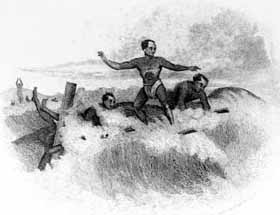
The
explorers reported that local young men were playing in the tides of
Kealakekua Bay on the Kona coast of the Big Island with wooden
boards, lying or standing on them .
Lt. King was impressed as the
men mastered heavy tides standing on their board. He also reported
that the men could
be said to be almost amphibious
due to their ability to evade the reef:
 |
| Sketch of the first surfers |
"If the Swell
drives him [The surfer] close to the rocks before he is overtaken by its break, he
is much prais'd. On first seeing this very dangerous diversion I did not
conceive it possible but that some of them must be dashed to mummy
against the sharp rocks, but jus before they reach the shore, if they
are very near, they quit their plank, & dive under till the Surf is
broke, when the piece of plank is sent many yards by the force of the
Surf from the beach. The greatest number are generally overtaken by the
break of the swell, the force of which they avoid, diving and swimming
under the water out of its impulse."
The
anthropologist that studied the Polynesian
civilization
believe that surfing
played
an important part in the social and religious life of the
Hawaiians .
The society was divided between the royal family and the commoners
and thus the beaches were also divided between those two castes .
And people were remembered
through songs by their deed or misdeed in Surf.
Kings like Kamehameha I, were renowned
for their surfing ability and praised
by the following generation.
As the European set foot in
Hawaii ,
the previous ruling system was overthrown and surfing lost its ritual
place in the society. Missionaries
even worsen the sport has it was view to a game and
therefore wasn't suited for working men. Moreover, disease and
the alcohol
decimated
the population decreasing from around 600,000 people to
40,000 native people in a century. Thus, at the beginning
of the 20th century, surfing was almost dead.
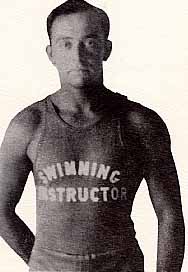
 |
| George Freeth |
But
in 1907, Jack London, already famous for White
Fang, The Sea Wolf and The
Call of the Wild,
came to Hawaii .
He met
Alexender Hume Ford, and the surf legend George Freeth at the Waikiki
Swimming Club who introduced him to the kings' sport, the Surf.
London described it in a novel called A
royal sport, surfing in Waikiki and
from this started the ascension
of surfing into the sport we know today.
The
description of George Freeth interested the real estate baron and
railroad constructor Henry Huntington who invited Freeth to surf in
California to promote his new line between Redondo and Los Angeles.
Then Freeth traveled along the California Coast to promote surfing.
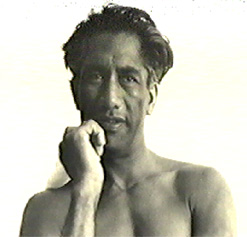
 |
| Duke Kahanamoku |
Back
in Hawaii ,
two clubs emerged at
the Waikiki beach as the
real estate and the tourism grew, the Hui Nalu (surf club in
Hawaiian) and the Waikiki swimming Club. Those two clubs started
doing demonstrations
and competitions
and the number of participants
raised from a hundred members in 1911 to over 1200 in
1915. Among them
was the one that really got the surf
international, Duke Kahanamoku. He was the fastest swimmer in Hawaii
and proved
to be the fastest in the world in the Stockholm and Antwerp Olympics. During his travels, he promoted
surfing on the beaches of California and Australia. This contributed
greatly to making this sport popular.
Finally, Hollywood
movies and improvement
of the photography in the water rendered possible
the exportation of images of the sports and finish rooting
this
sport in the Oceans' coast life style. We will see in a later article
that the 60s and 70s made the surf more than a sport and developed a
real culture around it.
 One of the most
famous threats in surfing is the shark attacks. This is mainly due
to different Hollywood's movies that created this myth of man eating
sharks. There is not so many shark attack on surfers. But it is true
that surfing increase risks of getting bitten by a shark. Sharks see
the surfboard a they could see otters, that are their principal prey
along coasts. Thus sharks attack more easily surfers. But this number
is still small as their were a total of 53 attacks in 2013 and only
600 people died from shark attacks in the past 60 years. However some
shark attacks still occur in surfing and boards bitten by sharks make
nice trophee.
One of the most
famous threats in surfing is the shark attacks. This is mainly due
to different Hollywood's movies that created this myth of man eating
sharks. There is not so many shark attack on surfers. But it is true
that surfing increase risks of getting bitten by a shark. Sharks see
the surfboard a they could see otters, that are their principal prey
along coasts. Thus sharks attack more easily surfers. But this number
is still small as their were a total of 53 attacks in 2013 and only
600 people died from shark attacks in the past 60 years. However some
shark attacks still occur in surfing and boards bitten by sharks make
nice trophee. Another danger of
surfing is the possibility to be taken to the sea by currents. The
stronger sweel often come with wind and this create big currents that
can get surfers carried away from shore, sometimes very far from the
coast. One of this phenomena is called baïne. It appears in specific
place, mainly in Gironde, France. It is part of the beach were a
really strong current is going out shore. The stream can get surfers very far away from the shore and gets them stranded. Each year, coast guard all around the world have to get inattentive surfers out of delicate situation. The emergence of kitesurfing has even increase this derives as the wind carries some practicer away along with the stream.
Another danger of
surfing is the possibility to be taken to the sea by currents. The
stronger sweel often come with wind and this create big currents that
can get surfers carried away from shore, sometimes very far from the
coast. One of this phenomena is called baïne. It appears in specific
place, mainly in Gironde, France. It is part of the beach were a
really strong current is going out shore. The stream can get surfers very far away from the shore and gets them stranded. Each year, coast guard all around the world have to get inattentive surfers out of delicate situation. The emergence of kitesurfing has even increase this derives as the wind carries some practicer away along with the stream.